Body Awareness Exercises for Beginners
Body awareness exercises for beginners can help you move with more ease, reduce unnecessary tension, improve posture, and feel more connected to how your body responds throughout the day. Many people spend years moving on autopilot, pushing through stiffness, shallow breathing, or stress without noticing the small physical signals that show up first. Learning body awareness does not require advanced fitness, complicated routines, or long workouts. It begins with simple, intentional practices that help you notice posture, breath, balance, muscle tension, and internal sensations in a calmer, clearer way.
For beginners, this kind of practice can be surprisingly powerful. It can make everyday activities feel smoother, help you recognize stress earlier, improve movement quality, and support better sleep and emotional regulation. If you want a broader foundation for building physical and mental balance, explore our complete guide to holistic wellness. This article focuses specifically on beginner-friendly body awareness exercises you can start using right away at home.
What Is Body Awareness?
Body awareness is the ability to notice what is happening inside your body in real time. That includes posture, muscle tension, breath rhythm, pressure through the feet, balance, alignment, fatigue, and subtle internal sensations such as tightness, ease, warmth, or discomfort. It also includes how different parts of the body work together during movement.
In practical terms, body awareness means noticing that your shoulders are lifted while working, that you are clenching your jaw during stress, that your breathing becomes shallow when anxious, or that one hip takes more load when you stand. Once you can notice these patterns, you have a much better chance of changing them.
Why body awareness matters in daily life
Many common complaints are made worse by poor body awareness. Neck tension, lower back discomfort, poor posture, shallow breathing, and repeated movement strain often build slowly because the body adapts to habits we rarely question. Awareness exercises help interrupt that process before it becomes more serious.
The difference between body awareness and general exercise
General exercise often emphasizes output such as calories burned, repetitions completed, or distance covered. Body awareness practice emphasizes how you move and what you feel while moving. It focuses more on sensing, quality, timing, control, and nervous system regulation than on intensity or performance.
Why Body Awareness Exercises Help Beginners So Much
Beginners often benefit quickly because they are not trying to unlearn advanced patterns or chase performance goals. They simply need a way to reconnect with the body. Even a few minutes a day can improve how you sit, stand, breathe, walk, and respond to stress.
They improve posture naturally
Posture improves when you can feel it. Instead of forcing yourself to “sit up straight” all day, body awareness teaches you to notice slumping, rib flare, shoulder tension, or head-forward posture and then make small, sustainable corrections.
They reduce unconscious tension
Many people tense muscles without realizing it. Common areas include the jaw, neck, shoulders, lower back, stomach, and hips. Gentle body awareness practice helps bring those areas into focus so they can soften.
They support emotional regulation
Stress and anxiety often show up in the body before the mind fully names them. Increased heart rate, tight breathing, restlessness, chest tension, and digestive discomfort are all physical cues. By noticing those cues earlier, you can respond more calmly rather than getting pulled deeper into stress.
Benefits of Body Awareness Exercises for Beginners
When practiced consistently, body awareness exercises can support both physical comfort and mental calm.
Physical benefits
- better posture and alignment
- improved balance and coordination
- less unnecessary muscle tension
- smoother movement patterns
- greater joint control and body stability
- reduced risk of movement-related strain
Mental and emotional benefits
- lower stress reactivity
- better focus and present-moment attention
- improved sleep readiness
- greater emotional awareness
- a calmer relationship with discomfort and tension
Partial Match H2: Beginner Body Awareness Practices That Improve Posture and Calm
The most effective beginner body awareness practices are usually the simplest ones. You do not need to do everything at once. Start with exercises that teach you how to feel your breath, posture, feet, spine, and muscle tension. Those small skills create the base for everything else.
Start with curiosity, not correction
The goal is not to judge your body or force perfect posture. The goal is to observe. Notice how you breathe, where tension gathers, how your weight shifts, and which side of the body works harder. Change becomes much easier when it starts from honest noticing instead of criticism.
Use short sessions consistently
Five to ten minutes daily is often more useful than a single long session once a week. Body awareness develops through repetition, not intensity.
How to Prepare for Body Awareness Practice
You do not need much equipment. A quiet corner, comfortable clothing, and a chair or mat are enough for most beginner exercises.
Create a simple setup
Choose a space where you can stand, sit, or lie down comfortably without distractions. A yoga mat, folded towel, or firm carpet can help, but none of it is mandatory. You may also want a chair for seated options or balance support.
Choose a realistic time
Many people do well with body awareness practice in the morning, after work, or before bed. The best time is the one you can repeat. If stress tends to build during the day, pairing this with an evening routine for body and mind balance can work especially well.
Follow simple safety rules
Move slowly. Stay within a comfortable range. Stop if you feel sharp, radiating, or worsening pain. Mild stretch, effort, and awareness of tension are normal. Pain is not the goal.
Core Body Awareness Exercises for Beginners
The exercises below build foundational awareness of breath, posture, spinal movement, muscular tension, and balance. They are beginner-friendly and easy to modify.
1. Body Scan
The body scan is one of the best starting points because it teaches you to notice sensation without needing to move much at all.
How to do it:
- Lie down or sit comfortably.
- Close your eyes or soften your gaze.
- Bring attention to your feet and slowly move upward through the body.
- Notice pressure, temperature, tension, ease, heaviness, or restlessness.
- Spend 1 to 2 breaths on each area.
Why it helps: It improves interoception, lowers mental noise, and helps you notice where you habitually hold tension.
2. Breath Awareness
Breath awareness helps regulate the nervous system and makes many other body awareness practices easier.
How to do it:
- Sit or lie in a comfortable position.
- Place one hand on your chest and one on your abdomen.
- Notice where the breath moves most naturally.
- Watch the inhale and exhale without forcing them.
- Stay with the breath for 3 to 5 minutes.
Beginner cue: Let the breath become slower naturally rather than trying to control it too quickly.
3. Progressive Muscle Relaxation
This exercise is especially helpful if you often feel tense but cannot easily tell where the tension is stored.
How to do it:
- Start at the feet or hands.
- Gently tense one muscle group for 5 seconds.
- Release slowly and rest for 15 to 20 seconds.
- Move to the next area: calves, thighs, hips, abdomen, shoulders, hands, face.
Why it helps: It teaches the difference between tension and release, which is a core part of body awareness.
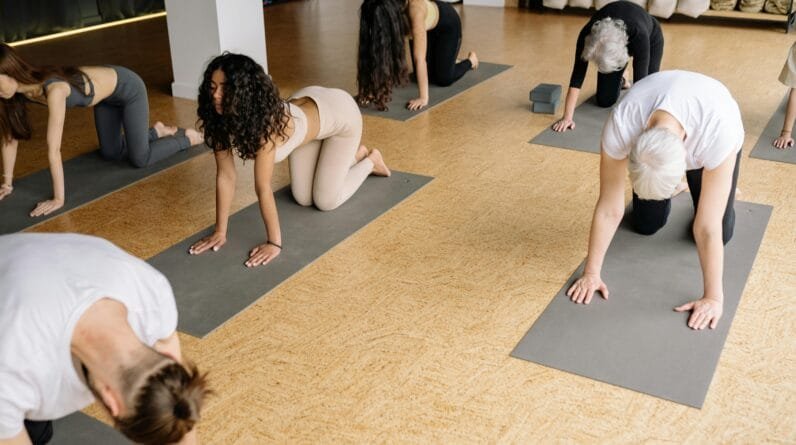
4. Cat-Cow Spinal Movement
Cat-cow improves spinal mobility and helps you feel how movement connects with breath.
How to do it:
- Come onto hands and knees, or sit and place hands on thighs if kneeling is uncomfortable.
- As you inhale, gently arch the spine and lift the chest.
- As you exhale, round the spine and soften the head and neck.
- Repeat for 8 to 12 slow cycles.
Focus point: Notice where movement feels easy and where it feels restricted.
5. Pelvic Tilts
Pelvic tilts help reconnect the low back, pelvis, and deep abdominal area. They are especially useful for people who sit a lot or feel disconnected from their core.
How to do it:
- Lie on your back with knees bent.
- On the exhale, gently flatten the low back into the floor.
- On the inhale, return to neutral.
- Repeat 8 to 15 times slowly.
6. Standing Weight Shift
This simple exercise improves awareness of the feet, balance, and how body weight moves from side to side.
How to do it:
- Stand with feet hip-width apart.
- Slowly shift weight into the right foot without leaning hard.
- Move back to center, then into the left foot.
- Repeat for 1 to 2 minutes.
Why it helps: It teaches grounding, balance control, and lower-body awareness without requiring a difficult exercise.
7. Single-Leg Balance with Support
Balance work is one of the fastest ways to improve proprioception, especially for beginners and older adults.
How to do it:
- Stand near a wall or chair.
- Lift one foot slightly off the floor.
- Keep the standing knee soft and your gaze steady.
- Hold for 20 to 30 seconds, then switch sides.
Beginner tip: A light fingertip on a chair still counts. The goal is awareness, not proving balance.
8. Heel-to-Toe Walking
This helps build coordination, foot awareness, and controlled movement in a functional way.
How to do it:
- Walk in a straight line.
- Place the heel of one foot directly in front of the toes of the other.
- Move slowly and deliberately for 5 to 10 steps.
- Turn and repeat.
9. Grounding Through the 5-4-3-2-1 Senses
This is especially helpful during stress or overwhelm because it brings awareness back into the body and environment.
How to do it:
- Name 5 things you can see.
- Name 4 things you can feel.
- Name 3 things you can hear.
- Name 2 things you can smell.
- Name 1 thing you can taste.
Why it helps: It interrupts spiraling mental activity and reconnects you with the present moment physically.
Related Variations H2: Simple Body Awareness Routines for Stress, Posture, and Daily Function
Once you understand the core exercises, you can combine them into short routines based on your needs.
5-minute reset for busy days
- 1 minute breath awareness
- 1 minute standing weight shifts
- 1 minute shoulder rolls and neck release
- 1 minute cat-cow or seated spinal movement
- 1 minute grounding or body scan
10-minute evening routine
- 2 minutes breath awareness
- 3 minutes body scan
- 2 minutes pelvic tilts
- 2 minutes progressive muscle relaxation
- 1 minute gratitude or quiet reflection
Desk-worker posture routine
- seated chin tucks
- shoulder blade squeezes
- standing chest opening
- cat-cow at a desk or countertop
- standing weight distribution check
Related Variations H2: Beginner Somatic and Proprioception Exercises That Build Confidence
As confidence grows, body awareness can blend into movement systems like yoga, Pilates, mobility work, and gentle strength training. At that point, the goal is not only to notice the body at rest, but to stay aware while moving through daily life.
That means noticing how your feet contact the floor while walking, how your breath changes during stress, how your posture shifts when tired, or how one side of your body compensates for the other. If you want to build on this further, you may also benefit from our holistic body and mind healing practices.
Common Mistakes Beginners Make
Trying to do too much too soon
Body awareness improves through repetition, not intensity. Start small and repeat often.
Judging sensations too quickly
You do not need every sensation to feel good. The skill is noticing clearly, not forcing perfection.
Ignoring pain signals
Discomfort and stretch can be normal. Sharp pain, tingling, or worsening symptoms should not be pushed through.
Being inconsistent
Five minutes daily beats 40 minutes once a week. Repetition is what helps the nervous system learn.
How to Track Progress with Body Awareness Exercises
Progress is often subtle at first, but it becomes obvious over time. You may notice you sit with less tension, feel your feet more clearly while standing, recover from stress faster, or wake with less stiffness.
Things worth tracking
- how many days per week you practice
- single-leg balance time
- sleep quality
- self-rated tension level from 0 to 10
- neck, jaw, shoulder, or low-back tightness
- how quickly you notice stress in the body
A simple note in your phone or journal is enough. You do not need a complicated tracking system.
When to Seek Professional Help
Body awareness exercises are beginner-friendly, but they are not a replacement for medical care. If you have severe pain, balance problems, recent surgery, neurological symptoms, unexplained weakness, or persistent worsening discomfort, speak with a medical professional or physical therapist.
Professional guidance is especially helpful if your pain is chronic, your movement feels highly restricted, or body-focused practice brings up overwhelming emotional responses.
Frequently Asked Questions
What are body awareness exercises for beginners?
Body awareness exercises for beginners are simple practices that help you notice posture, breath, tension, balance, and movement patterns more clearly. Examples include body scans, breath awareness, pelvic tilts, cat-cow, standing balance, and grounding exercises. They are designed to improve movement quality and reduce stress without requiring advanced fitness.
How often should beginners practice body awareness exercises?
Beginners usually benefit most from short daily practice. Even 5 to 10 minutes a day can improve body awareness over time. Consistency matters more than long sessions, so a small routine you can maintain regularly is usually the best approach.
Can body awareness exercises help with posture?
Yes, body awareness exercises can help posture because they teach you to notice how you sit, stand, and move. Instead of forcing a rigid position, they improve awareness of alignment, muscle tension, and balance so posture can become more natural and less tiring.
Do body awareness exercises help with anxiety and stress?
They often do. Many body awareness exercises include breath regulation, grounding, and noticing physical tension patterns, which can help calm the nervous system. They are not a cure for anxiety, but they can be a useful part of a broader stress-management routine.
Are body awareness exercises safe for older adults?
In many cases, yes. They can be especially useful for improving balance, posture, and movement confidence. Seated or supported variations are often appropriate. Anyone with significant medical concerns, recent surgery, or serious balance problems should get personalized guidance first.
How long does it take to notice results from body awareness practice?
Some people notice immediate small changes such as less tension or a calmer breath after one session. More meaningful changes in posture, coordination, body tension, and stress response often build over several weeks of consistent practice.
Final Thoughts
Body awareness exercises for beginners are not about doing more. They are about noticing more. They teach you how to feel your posture, your breath, your balance, your tension patterns, and your responses to stress with greater clarity and less judgment.
That awareness becomes useful everywhere. It can improve how you sit at work, how you walk, how you recover after stress, how you sleep, and how you respond to discomfort before it builds into something bigger. Start with a few simple exercises, keep the routine short, and let consistency do the work. Over time, small moments of awareness can create a much calmer, steadier relationship with your body.