Daily Fitness Exercises for Wellness – Simple Habits for a Healthier Life
Daily Fitness Exercises for Wellness . This guide shows you how to build strength, muscle, aerobic fitness, stability, and manage body fat using bodyweight-only routines you can do in any room. You’ll find 30 exercises split into beginner, intermediate, and advanced groups, clear sets/reps guidance, progressions, and safety cues so you can start where you’re comfortable and move up gradually.
How to use this guide
You’ll find three routines — beginner, intermediate, and advanced — each containing 10 exercises. Read the short descriptions and cues, try the recommended sets and reps (or timed rounds), and progress by removing support, adding single-leg or unilateral moves, increasing time under tension, or switching to timed rounds.
Who this is for
This plan works whether you’re just starting, returning after a break, or already fit and looking to push limits without equipment. If you have health concerns or injuries, check with a clinician before starting and modify as needed.
Quick overview table: routines at a glance
This table summarizes each routine so you can compare at a glance.
| Level | Number of moves | Typical format | Suggested duration |
|---|---|---|---|
| Beginner | 10 | 2 sets of 10–15 reps per exercise; 30–60s rest | ~15–20 minutes |
| Intermediate | 10 | 2 sets of 10–15 reps or 1-minute rounds; 30–60s rest | ~20–30 minutes |
| Advanced | 10 | 2–3 sets of 6–12 reps or timed 45–90s rounds; 45–90s rest | ~30–40+ minutes |
Safety first
A couple of quick safety reminders before you begin. Warm up for 5–10 minutes with light cardio (marching in place, arm circles) and dynamic mobility, focus on quality of movement over quantity, and stop if you feel sharp pain. Use a chair, wall, or knee support when needed to protect joints.
Beginner routine — fundamentals and mobility
Start here if you’re new to consistent training, returning after a layoff, or prefer lower-impact work. This set builds basic strength, balance, and movement quality, and is intended to be approachable while still effective.
- Format: 2 sets of 10–15 reps per exercise
- Rest: 30–60 seconds between sets/exercises
- Estimated duration: ~15–20 minutes
| # | Exercise | Short purpose |
|---|---|---|
| 1 | Glute bridge | Hip extension, posterior chain activation |
| 2 | Chair squat (sit-to-stand) | Safe squat pattern and leg strength |
| 3 | Knee push-up | Horizontal pressing with reduced load |
| 4 | Stationary lunge | Single-leg strength and hip control |
| 5 | Plank-to-downward dog | Core plus shoulder mobility |
| 6 | Bird dog | Low-back and core coordination |
| 7 | Forearm plank | Core endurance and spinal stability |
| 8 | Bicycle crunch | Core rotation and hip flexor control |
| 9 | Standing calf raise | Ankle strength and balance |
| 10 | Wall-supported single-leg balance | Balance and ankle stability |
1. Glute bridge
Lie on your back with knees bent and feet hip-width. Drive through your heels to lift hips until your body forms a straight line from shoulders to knees, squeeze glutes at the top, then lower with control.
- Cues: Keep ribcage down, squeeze glutes, avoid overextending the lower back.
- Progression: Add a single-leg bridge when ready.
2. Chair squat (sit-to-stand)
Stand in front of a chair and lower yourself to light touch the seat, then stand up using your legs. This teaches safe depth and control.
- Cues: Sit back into the hips, keep knees tracking over toes, chest upright.
- Progression: Remove the chair support and perform full bodyweight squats.
3. Knee push-up
From a high plank but with knees on the floor, lower your chest to a target and press up. This builds pressing strength with less load.
- Cues: Keep a straight line from knees to head, lower under control, avoid flaring elbows too wide.
- Progression: Move to standard push-ups on toes.
4. Stationary lunge
Step into a split stance and lower your back knee toward the floor, keeping the front knee aligned over the ankle. Perform all reps on one side, then switch.
- Cues: Keep hips square, torso upright, and front knee tracking over toes.
- Progression: Increase range or switch to walking lunges.
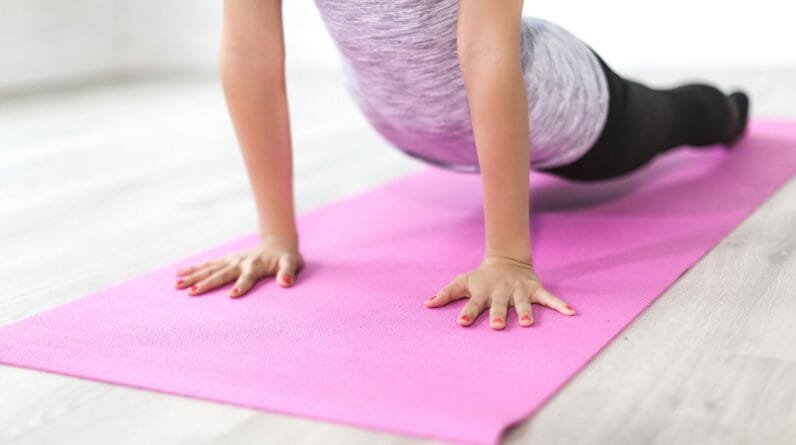
5. Plank-to-downward dog
Start in a high plank, push back to press your hips up and back into downward dog, then return to plank. This mixes core stability with shoulder mobility.
- Cues: Move slowly, breathe, keep shoulders away from ears.
- Progression: Hold the downward dog longer or add alternating leg lifts.
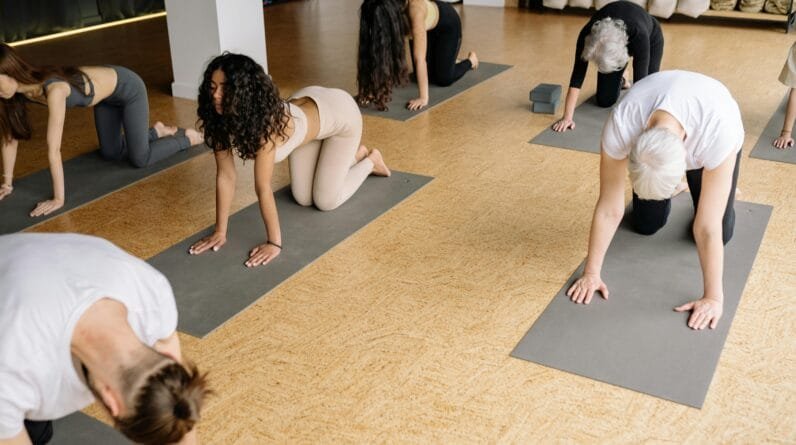
6. Bird dog
On hands and knees, extend opposite arm and leg until they’re in line with your torso, pause, then switch sides. This enhances core control and spinal stability.
- Cues: Avoid rotating the hips, tuck the ribs slightly to neutralize the spine.
- Progression: Add a 1–2 second hold at full extension.
7. Forearm plank
Hold a neutral spine position on forearms and toes, engaging the core and glutes. Aim for quality holds rather than maximum time right away.
- Cues: Keep hips level, pull belly button toward spine, avoid sagging.
- Progression: Move to higher duration or alternate with side planks.
8. Bicycle crunch
Lie on your back with hands behind your head; bring opposite elbow to knee with a controlled rotation while the other leg extends, alternating sides.
- Cues: Keep neck relaxed, use the core to rotate rather than pulling on your head.
- Progression: Slow the tempo to increase time under tension.
9. Standing calf raise
Stand tall and lift heels to rise onto your toes, pause at the top, then lower. This strengthens calves and improves ankle stability for functional movement.
- Cues: Control the descent, avoid rolling the foot inward.
- Progression: Perform single-leg calf raises.
10. Wall-supported single-leg balance
Stand facing a wall and lightly touch it while lifting one foot off the ground and balancing on the other. Hold for time, then switch.
- Cues: Keep hips level and knees soft, maintain a steady gaze to reduce sway.
- Progression: Remove the wall touch or close your eyes.
Intermediate routine — more challenge, unilateral work, and travel variations
Move here once the beginner routine becomes easy for the specified sets and reps. This level introduces single-leg work, more intense push and core patterns, and traveling movements to increase demand.
- Format: 2 sets of 10–15 reps per exercise OR 1-minute rounds
- Rest: 30–60 seconds between sets/exercises
- Estimated duration: ~20–30 minutes
Intermediate exercise list (10)
| # | Exercise | Short purpose |
|---|---|---|
| 1 | Bridged march | Single-leg hip drive and core control |
| 2 | Full squat | Deeper, loaded bodyweight squatting |
| 3 | Standard push-up | Full horizontal pressing and core tension |
| 4 | Forward/backward lunge (walking or reverse) | Dynamic single-leg strength |
| 5 | Pike push-up | Vertical pressing foundation |
| 6 | Plank with alternating leg lifts | Core stability with posterior chain demand |
| 7 | Dead bug | Controlled anti-extension core work |
| 8 | Single-leg glute bridge | Increased hip extensor load |
| 9 | Inchworm | Hamstring mobility plus core control |
| 10 | Superman hold | Posterior chain strengthening and scapular control |
1. Bridged march
From a glute bridge position, lift one knee toward your chest while keeping hips level, alternate sides like a marching pattern. This taxes glutes and trains anti-rotation.
- Cues: Keep hips steady, don’t let one hip drop as you lift the knee.
- Progression: Hold each march at the top for 2–3 seconds or move to single-leg bridge.
2. Full squat
Stand with feet hip-to-shoulder width, sit back and down into full depth as mobility allows, then stand. This builds leg strength and core control.
- Cues: Keep weight in heels, chest up, knees tracking over toes.
- Progression: Slow the eccentric (lowering) phase to increase time under tension.
3. Standard push-up
Start in a high plank and lower your chest to the ground before pressing up. This is a fundamental pressing pattern that also taxes core and shoulders.
- Cues: Maintain a straight line from heels to head, avoid sagging hips.
- Progression: Add an elevated tempo or increase reps per set.
4. Forward/backward lunge (walking or reverse)
Perform lunges moving forward (walking) or lowering backward (reverse), focusing on control and hip drive on the standing leg.
- Cues: Step with intention, keep torso tall, push through the front heel to return.
- Progression: Add a forward hop or increase step length for extra challenge.
5. Pike push-up
From a pike or downward dog position, bend elbows and lower head toward the ground, then press back up. This preps vertical pressing and shoulder strength.
- Cues: Lead with the top of your head toward the floor, keep elbows pointed out at about 45 degrees.
- Progression: Elevate your feet to increase vertical load or move toward wall-assisted handstand push-ups.
6. Plank with alternating leg lifts
Hold a plank and lift one leg off the floor, lower it, then lift the other. This integrates hip extension into your anti-extension core work.
- Cues: Keep hips level and core engaged; avoid rotating as you lift.
- Progression: Increase hold duration or perform from forearms if easier.
7. Dead bug
Lie on your back with arms extended up and knees bent; slowly lower opposite arm and leg toward the floor while keeping the lower back pressed to the mat, then return.
- Cues: Move slowly, keep lower back contact, and breathe out during the lowering phase.
- Progression: Straighten legs more as you gain control, or add a pause at the bottom.
8. Single-leg glute bridge
Perform the glute bridge but extend one leg while lifting hips with the other. This increases gluteal and hamstring demand unilaterally.
- Cues: Keep hips level and avoid rotating; push through the heel of the working leg.
- Progression: Slow the lowering phase or increase reps.
9. Inchworm
From standing, hinge at the hips, walk your hands out to a high plank, optionally perform a push-up, then walk hands back and stand. This trains hamstrings, shoulders, and core.
- Cues: Move with control and keep a neutral spine on the way down.
- Progression: Add a push-up at the plank portion or perform a walk-back with a slow tempo.
10. Superman hold
Lie prone and lift chest and legs off the ground, holding the contraction for time. This strengthens the posterior chain and spinal erectors.
- Cues: Squeeze glutes and upper back, breathe steadily.
- Progression: Alternate opposite arm/leg lifts in an extended bird dog pattern.

Advanced routine — unilateral strength, balance, and power
This level is for experienced exercisers who want high-skill, high-strength, or explosive bodyweight challenges. Expect more single-leg demands, unilateral pressing, vertical load, and plyometrics.
- Format: 2–3 sets of 6–12 reps OR timed rounds of 45–90 seconds
- Rest: 45–90 seconds
- Estimated duration: ~30–40+ minutes
Advanced exercise list (10)
| # | Exercise | Short purpose |
|---|---|---|
| 1 | Pistol squat | Full single-leg squat for strength and mobility |
| 2 | One-arm push-up | Maximal unilateral pressing strength |
| 3 | Handstand push-up (wall-assisted) | Vertical pressing and shoulder strength |
| 4 | Shrimp squat | Deep single-leg strength and mobility |
| 5 | Archer push-up | Asymmetric pressing and stability |
| 6 | Plyometric (explosive) push-up | Power development and fast-twitch recruitment |
| 7 | L-sit (floor) | Intense core and hip flexor isometric hold |
| 8 | Tuck planche progression | Advanced anterior chain and shoulder strength |
| 9 | Single-leg Romanian deadlift (bodyweight reach) | Hamstring strength, balance, and hinge control |
| 10 | Skater hops / bounding lunge | Lateral power and single-leg explosiveness |
1. Pistol squat
Stand on one foot and lower yourself into a full one-legged squat while the other leg extends forward, then rise back up. This requires strength, flexibility, and balance.
- Cues: Sit back on the heel, keep the extended leg straight, and stay as upright as mobility allows.
- Progression: Practice to a box or use a counterbalance (light object or arm) until strength builds.
2. One-arm push-up
Perform a push-up pushing from one hand with feet set wider for stability; lower and press with control. This is a highly demanding unilateral pushing movement.
- Cues: Keep hips square, brace your core hard, and position the supporting foot to aid balance.
- Progression: Work toward it from elevated surfaces and offset hand placements.
3. Handstand push-up (wall-assisted)
Kick up into a wall handstand and perform vertical presses by lowering your head to the ground and pushing back up. This builds shoulder strength and body awareness.
- Cues: Keep the core braced and neck neutral, tuck chin slightly on descent.
- Progression: Practice partial range of motion, negative-only reps, and wall walks.
4. Shrimp squat
Stand on one leg, hold the other foot behind you by the hand, and lower toward a squat position before standing up. This challenges depth and single-leg control.
- Cues: Keep the torso upright and descend slowly; use the hand to gradually increase depth.
- Progression: Work on assisted shrimp squats and increase range over time.
5. Archer push-up
From a wide push-up position shift your weight over one arm while the other arm remains extended, creating an asymmetry that builds unilateral strength. Alternate sides.
- Cues: Move with control and focus on the loaded side’s elbow tracking.
- Progression: Increase depth or move toward one-arm push-ups.
6. Plyometric (explosive) push-up
Perform a push-up with enough force to lift your hands off the ground (clap optional). This trains explosive upper-body power.
- Cues: Use the hips to maintain a straight line; land softly to reduce joint stress.
- Progression: Increase height or perform from an elevated surface to manage load.
7. L-sit (floor)
Sit between your hands with legs extended and press up so your body is off the floor in an L shape; hold that position. This develops intense midline strength and hip flexor endurance.
- Cues: Press actively through your hands, keep legs straight and toes pointed.
- Progression: Tuck L-sits or use parallettes to reduce wrist strain.
8. Tuck planche progression
From a downward-facing position, hold your body off the ground with shoulders protracted and legs tucked. This is a high-skill move for shoulders, chest, and anterior core.
- Cues: Keep shoulders pressed down and forward, maintain a tight core.
- Progression: Gradually extend one leg at a time toward full planche.
9. Single-leg Romanian deadlift (bodyweight reach)
Hinge at your hips on one leg, reach forward with both hands while the free leg moves back, return to standing. This trains hamstring strength, balance, and hip hinge mechanics.
- Cues: Keep a small bend in the supporting knee and maintain a neutral spine.
- Progression: Reach farther or pause at full hinge to increase demand.
10. Skater hops / bounding lunge
Perform lateral jumps from one foot to the other like a speed skater, or perform explosive forward lunges with a bounding step. These build lateral power and single-leg explosiveness.
- Cues: Land softly, absorb force through a bent knee, and use arms to drive momentum.
- Progression: Increase distance or add a quick change-of-direction component.
Sample workouts you can follow
Use the following templates to structure an entire session. Adjust intensity, rest, and rep counts to match your current ability.
Beginner sample session (~18 minutes)
- Warm-up: 5 minutes (marching, leg swings, arm circles)
- Circuit (2 rounds): 10–15 reps each, 30–45s rest between exercises
- Chair squat
- Knee push-up
- Glute bridge
- Stationary lunge (10–12 each side)
- Forearm plank (30s)
- Bird dog (10 reps per side)
- Bicycle crunch (12–15 per side)
- Plank-to-downward dog (8–10 reps)
- Standing calf raise (15 reps)
- Wall-supported single-leg balance (30s each leg)
- Cool-down: 3–5 minutes of gentle stretching
Intermediate sample session (~25 minutes)
- Warm-up: 6 minutes (light cardio, hip mobility, shoulder circles)
- Option A — Strength format (2 sets of 10–12 reps):
- Full squat
- Standard push-up
- Bridged march (10 per side)
- Reverse lunge (10 per leg)
- Pike push-up (8–12 reps)
- Plank with alternating leg lifts (10 per side)
- Dead bug (12 per side)
- Single-leg glute bridge (10 per leg)
- Inchworm (8–10 reps)
- Superman hold (30–45s)
- Cool-down: 4–6 minutes stretching and breathing
Advanced sample session (~35 minutes)
- Warm-up: 8 minutes (dynamic mobility, wrist prep, light plyos)
- Circuit (3 rounds, 45s work / 60s rest or 6–10 reps each):
- Pistol squat (6–8 per leg)
- One-arm push-up progressions or archer push-up (6–8 per side)
- Handstand push-up negatives or partials (6–8)
- Shrimp squat (6–8 per leg)
- Plyometric push-ups (8–10)
- L-sit hold (20–40s)
- Tuck planche hold or progression holds (15–30s)
- Single-leg Romanian deadlift reach (8–10 per leg)
- Skater hops (30–45s)
- Core finisher: hollow body hold (30–45s)
- Cool-down: 6–8 minutes including shoulder and hip mobility work
Progression principles — how to get better safely
Progression matters more than intensity spikes. Increase difficulty with these reliable methods:
- Remove supports: move from two feet to one, from knees to toes, from wall to freestanding.
- Add unilateral (single-leg/arm) movements to increase demand and correct asymmetries.
- Increase time under tension: slow the eccentric (lowering) phase to 3–5 seconds.
- Switch from reps to timed rounds: this increases metabolic demand and consistency.
- Reduce rest gradually to improve endurance and conditioning.
- Prioritize movement quality: better form protects joints and builds stronger adaptations than simply doing more reps poorly.
Progressive overload checklist (short)
- Can you complete all sets and reps with good form? Increase difficulty.
- Can you control the lowering phase? Slow it down.
- Can you add a pause or hold at the most difficult point? Add a 1–3 second isometric.
- Are both sides symmetrical? Add extra reps/sets to the weaker side.

Bodyweight training delivers several functional and health improvements you can notice in daily life. These are the primary benefits and brief cues to get the most from each session.
Key benefits
- Improves everyday function: squatting, lifting, carrying, bending feel easier.
- Enhances posture: stronger posterior chain and core support better alignment.
- Builds core and hip strength: reduces lower-back pain risk and improves gait.
- Increases aerobic capacity: timed rounds or short rest intervals improve conditioning.
- Helps manage body fat: consistent workouts raise calorie burn and lean mass retention.
- Accessible and low-cost: no equipment and minimal space required.
Short movement cues to use every workout
- Hips and shoulders square: maintain symmetry during single-leg and rotational moves.
- Neutral spine: tuck your chin slightly and avoid excessive arching or rounding.
- Breath control: exhale on the exertion phase (press or lift), inhale on the return.
- Knee alignment: keep knees tracking over toes, avoid caving inward.
- Progressive overload: increase difficulty slowly to avoid injuries.
Modifications and common adjustments
You’ll sometimes need to change an exercise to match your current mobility or strength. Use these straightforward modifications.
- Reduce range of motion: squat to a higher surface (chair) or perform partial push-ups.
- Add support: use a wall, chair, or band for balance during pistols or shrimp squats.
- Change tempo: slow the eccentric phase for strength, or speed it slightly for conditioning.
- Swap exercise: if you have wrist pain, perform forearm planks instead of high planks; use parallettes or fists to reduce wrist extension.
- Manage fatigue: cut a set early or reduce reps instead of forcing low-quality reps.
Practical notes for consistency
Staying consistent is the most powerful way to improve. Here are a few practical suggestions to help you keep going.
- Frequency: aim for 3–5 sessions per week depending on recovery and goals.
- Mix levels: you can combine beginner and intermediate moves in a session while you transition.
- Track progress: keep a simple log of reps, sets, and perceived effort to measure improvement.
- Recovery: include sleep, nutrition, and active recovery (light movement, mobility) to support adaptations.
- Time-efficient options: use circuits and timed rounds to complete effective sessions in 20–30 minutes.
Troubleshooting and frequently asked questions
A short FAQ to help with the most common concerns and obstacles.
Q: How fast will I see results?
- You’ll typically notice improved stamina and better movement quality in 2–4 weeks; visible changes in body composition can take 6–12 weeks with consistent training and diet.
Q: Can I build muscle with bodyweight training?
- Yes. Progressive increases in difficulty, unilateral moves, slower eccentrics, and short rest intervals can create enough stimulus for hypertrophy, especially for beginners and intermediates.
Q: What if my knees or shoulders hurt?
- Modify the movement to reduce load or range, focus on form, and strengthen surrounding musculature. If pain persists, stop and consult a healthcare professional.
Q: How do I transition from intermediate to advanced?
- Gradually introduce unilateral and explosive elements, practice skill-specific progressions (e.g., negatives, partial reps), and ensure foundational mobility is sufficient.
Example 8-week progression plan (brief)
This is a simple framework you can adapt.
- Weeks 1–2: Beginner routine 3x/week; focus on form and consistent sessions.
- Weeks 3–4: Beginner → Intermediate crossover: keep a couple of beginner moves as warm-up, then add 4–6 intermediate exercises.
- Weeks 5–6: Full intermediate routine 3–4x/week; introduce a weekly modded advanced skill practice (e.g., handstand negative).
- Weeks 7–8: Alternate intermediate and advanced sessions (2 intermediate, 1 advanced) and aim to improve reps or hold times each session.
Final tips to keep you moving forward
You’re building a sustainable habit, so be patient and celebrate small wins. Start where you’re comfortable, track progress, and prioritize recovery. If one exercise feels too challenging today, regress it and come back stronger tomorrow. Over time, consistent effort will translate into meaningful strength, better posture, improved function, and higher confidence without ever needing a gym.
If you want, tell me your current fitness level and a target you’d like to reach (strength, fat loss, skill work), and I’ll build a personalized 4-week microplan using these exercises.