Low Impact Exercises for Beginners to Build Strength and Mobility
This guide explains how beginners can safely build strength and mobility with low-impact movements, how to structure a weekly plan, how to progress over time, and how to choose exercises that fit real life. If you want a broader foundation for healthy living, you can also explore our pillar resource on healthy lifestyle for mind and body.
Can a beginner over 40 safely build strength and improve mobility using low-impact exercises that fit into a busy life and reduce injury risk? Yes, and the key is using the right exercises, the right pace, and the right expectations.
Why Low Impact Training Matters After 40
Low-impact training reduces stress on the joints while still creating enough challenge for muscles, bones, tendons, and the cardiovascular system to adapt. That makes it ideal for beginners, especially those returning to exercise after a long break, managing stiffness, or wanting to avoid the soreness and recovery burden that often comes with more aggressive training styles.
After 40, several common physical changes begin to matter more. Recovery tends to slow. Joint lubrication may decrease. Muscle tissue becomes easier to lose if it is not trained regularly. Balance and coordination may also become less sharp, especially for people who spend most of the day sitting. A good low-impact routine helps address all of these issues at once. It builds muscle, supports joint movement, improves posture, and increases confidence in daily movement without requiring jumping, pounding, or extreme effort.
Key Benefits of Low Impact Exercise
- Reduces stress on knees, hips, ankles, and lower back
- Builds practical strength for daily tasks
- Improves mobility and joint control
- Supports balance and fall prevention
- Enhances circulation, energy, and posture
- Feels more sustainable for long-term consistency
For many people, low-impact exercise is not a compromise. It is the most realistic path to regular training.
Why Strength and Mobility Should Be Trained Together
Strength and mobility work best together. Strength gives your body the ability to support itself, stabilize joints, and handle physical tasks with less effort. Mobility gives your joints the ability to move through healthy ranges of motion with control. If you only train strength without mobility, movement can become stiff or restricted. If you only focus on mobility without strength, you may gain range without the control needed to use it well.
That is why a well-designed beginner plan includes both. Sit-to-stands strengthen the legs and hips while also improving functional movement. Glute bridges build lower-body strength and help reduce stiffness from sitting. Shoulder mobility drills support better posture, while wall push-ups strengthen the upper body with a manageable joint load.
Functional Benefits in Everyday Life
One of the biggest advantages of low-impact strength and mobility training is that it improves normal daily activities. Walking upstairs, carrying shopping bags, standing up from a chair, reaching overhead, maintaining posture while working, and getting up from the floor all become easier when strength and mobility improve together.
These results often matter more than a number on a scale. Many beginners notice better movement confidence, less stiffness, and more daily energy before they notice visible physical changes.
Who Should Consider Low Impact Exercise Routines
Low-impact routines are especially useful for beginners, adults over 40, people returning after injury, and those dealing with joint discomfort, arthritis, lower energy, or fear of high-impact training. They are also ideal for people who want workouts that are effective without being intimidating.
This style of training may be a strong fit if you:
- Have been inactive for a while
- Feel stiff or weak from too much sitting
- Want to improve balance and coordination
- Have mild joint sensitivity or age-related aches
- Need a routine that fits home training
- Prefer gradual progress over extreme workouts
If you have a history of heart disease, uncontrolled blood pressure, recent surgery, severe osteoporosis, or unstable joint injuries, it is wise to get medical clearance before starting. A short conversation with a clinician or physical therapist can help identify any useful modifications.
How to Start Safely and Build Consistency
The most important rule for beginners is to start below your maximum. You do not need to prove fitness on day one. You need to build a routine your body can recover from and repeat next week. That usually means moderate effort, clean technique, and gradual progress.
Basic Training Principles for Beginners Over 40
- Begin with 2 to 3 strength sessions per week
- Focus on movement quality before increasing resistance or volume
- Leave at least one rest or light-activity day between harder sessions
- Use progressive overload slowly by adding reps, sets, or difficulty over time
- Stop and reassess if pain feels sharp, sudden, or joint-based
For beginners, consistency matters more than intensity. Three modest sessions done regularly will usually outperform a more ambitious plan that becomes too exhausting to maintain.
Minimal Equipment and Home Setup
One of the best things about low-impact training is that it does not require a gym. A few simple tools can cover most beginner needs.
Useful Equipment
- A sturdy chair for support and sit-to-stand work
- A non-slip mat for floor exercises
- Resistance bands for scalable strength work
- Light dumbbells if available, though not required
A clear space with good lighting and enough room to step, hinge, and reach is often enough. If you prefer a home-based approach with almost no equipment, this article pairs well with simple exercise routine without gym equipment.
Warm-Up: The Foundation for Safe Low Impact Training
A warm-up prepares joints, muscles, and the nervous system for exercise. It raises blood flow, improves movement quality, and reduces the chance that the first set of exercises will feel stiff or awkward.
A good warm-up does not need to be long. Five to ten minutes is usually enough.
Example Warm-Up Sequence
- 30 to 60 seconds marching in place
- 10 arm circles forward and backward
- 10 shoulder rolls
- 10 torso twists
- 10 hip circles
- 10 bodyweight hip hinges
- 10 ankle circles per side
- 5 to 8 gentle sit-to-stands
This creates a smooth transition from rest into the workout and improves how the body feels during the main session.
This image is property of images.unsplash.com.
Best Low Impact Exercises for Beginners to Build Strength and Mobility
The best beginner exercises are the ones that are safe, repeatable, and easy to progress. They should train the major movement patterns of daily life: sitting and standing, hinging at the hips, pushing, pulling, stepping, balancing, and stabilizing the core.
| Exercise | Primary targets | Equipment | Sets × Reps | Key form notes |
|---|---|---|---|---|
| Chair sit-to-stand | Quads, glutes | Chair | 2–3 × 8–15 | Press through heels, keep knees aligned, stand tall |
| Glute bridge | Glutes, hamstrings | Mat | 2–3 × 10–15 | Squeeze glutes and avoid over-arching the lower back |
| Wall push-up | Chest, shoulders, triceps | Wall | 2–3 × 8–15 | Keep body in a straight line and control the descent |
| Resistance band row | Upper back, biceps | Band | 2–3 × 10–15 | Pull elbows back and avoid shrugging the shoulders |
| Seated overhead press | Shoulders, triceps | Band or light dumbbells | 2–3 × 8–12 | Keep ribs down and avoid pressing through a strained back |
| Split-stance RDL | Hamstrings, glutes, balance | Bodyweight or light dumbbell | 2–3 × 8–12 each side | Hinge from hips, keep spine neutral, move slowly |
| Low step-up | Quads, glutes | Low step or stair | 2–3 × 8–12 each leg | Use the whole foot and control the way down |
| Lateral band walk | Hip stabilizers, glute medius | Band | 2–3 × 10–20 steps | Keep tension on the band and avoid leaning sideways |
| Standing calf raise | Calves, ankle support | Bodyweight | 2–3 × 10–20 | Lift slowly and lower with control |
| Single-leg balance hold | Balance, ankle and hip stability | None or chair support | 2–3 × 10–30 sec each side | Stand tall and use support if needed |
How to Structure a Weekly Low Impact Program
For most beginners over 40, a balanced weekly structure includes full-body strength sessions, mobility work, balance practice, and recovery days. This combination is enough to create progress without overwhelming the body.
Example Weekly Schedule
- Monday: Full-body strength session
- Tuesday: Mobility and balance work
- Wednesday: Full-body strength session
- Thursday: Light walking or mobility
- Friday: Full-body strength session
- Saturday: Active recovery such as walking, gardening, or stretching
- Sunday: Full rest or gentle mobility
This style of schedule supports recovery while keeping the body moving most days. It also pairs well with a broader simple daily fitness routine for people who want extra daily structure.
Sample Full-Body Beginner Workout
Below is a simple full-body session that works well for beginners over 40. It trains legs, hips, upper body, core, and balance without high impact.
Workout Structure
Perform the following exercises for 2 to 3 rounds. Rest 45 to 75 seconds between exercises if needed.
- Chair sit-to-stand — 10 to 12 reps
- Wall push-up — 8 to 12 reps
- Glute bridge — 10 to 15 reps
- Resistance band row — 10 to 15 reps
- Low step-up — 8 reps each leg
- Standing calf raise — 12 to 15 reps
- Single-leg balance hold — 15 to 20 seconds each side
Finish with 5 to 10 minutes of mobility work or light stretching.
Sample 8-Week Beginner Progression Plan
Beginners usually make the best progress when the plan changes gradually instead of all at once. An eight-week structure creates enough time for learning, adaptation, and confidence building.
Weeks 1–2: Foundation Phase
Use 2 sets per exercise. Focus on control, range of motion, and posture. Keep the effort moderate and avoid training to exhaustion. The main goal is learning the movements and finishing each session feeling capable rather than drained.
Weeks 3–4: Build Phase
Increase to 3 sets for most exercises or add a few repetitions per set. Start introducing simple balance work like longer single-leg stands or slower step-ups. Keep daily mobility drills short but regular.
Weeks 5–6: Progression Phase
Increase exercise difficulty slightly. Move wall push-ups to a kitchen counter or sturdy table for more challenge. Use a stronger band for rows or add light dumbbells to sit-to-stands and overhead presses if available. Continue focusing on controlled movement.
Weeks 7–8: Consolidation and Reassessment
By now, many movements should feel smoother and more stable. Reassess with simple measures such as:
- How many chair sit-to-stands you can do in 30 seconds
- How long you can balance on one leg
- Whether wall or incline push-ups feel easier
- Whether you feel less stiff getting up, bending, or walking stairs
These improvements are meaningful because they reflect real-life function, not just exercise performance.
This image is property of images.unsplash.com.
Detailed Coaching Tips for the Most Important Beginner Exercises
Chair Sit-to-Stand
Sit toward the front of the chair with your feet planted. Lean slightly forward from the hips, press through the heels, and stand up tall. Lower back down with control instead of dropping into the chair. This is one of the best functional movements for beginners because it directly supports everyday independence.
Glute Bridge
Lie on your back with knees bent and feet hip-width apart. Press through the heels and lift the hips until your body forms a straight line from shoulders to knees. Pause briefly, then lower slowly. Focus on squeezing the glutes rather than arching the lower back.
Wall Push-Up
Place hands on the wall at chest height and step your feet back until your body forms a straight line. Lower toward the wall with control, then press away. Keep shoulders relaxed and avoid letting the hips sag.
Resistance Band Row
Anchor the band securely at about chest height. Hold the ends, step back to create tension, and pull elbows toward your sides while squeezing shoulder blades gently together. Do not shrug the shoulders up toward the ears.
Step-Up
Use a low step or stair. Place the whole foot on the step, press through the heel, and stand up tall before lowering slowly. Avoid pushing too much from the trailing leg. Start low and controlled.
Mobility, Flexibility, and Balance: What Is the Difference?
These terms are often mixed together, but they are not exactly the same. Flexibility refers to the length of muscles and soft tissue. Mobility refers to how well a joint can move through its range with control. Balance refers to the ability to maintain stability in stillness or motion.
All three matter for adults over 40. Mobility and balance are especially important because they influence walking confidence, fall risk, posture, and joint comfort. That is why even strong people can benefit from dedicated mobility drills and balance work.
Simple Daily Mobility Drills
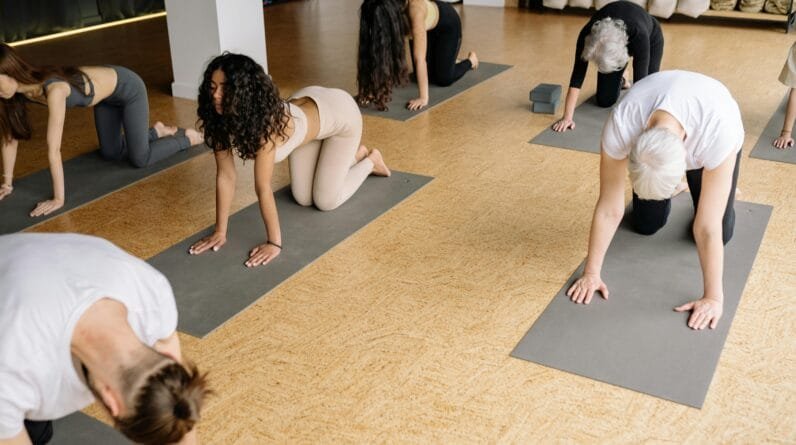
- Cat-cow spinal mobility
- Shoulder circles or band pass-throughs
- Hip circles
- Ankle circles
- Thoracic rotations
- Kneeling hip flexor stretch
Five to ten minutes a day is enough to make a difference when done consistently.
How to Progress Without Overdoing It
Beginners often make one of two mistakes. They either stay at the same easy level for too long, or they progress too quickly and get discouraged or sore. Smart progression means increasing challenge slowly while keeping movement quality high.
Easy Ways to Progress
- Add 1 or 2 reps per set
- Add one extra set
- Increase band resistance slightly
- Slow the lowering phase of each rep
- Increase balance time
- Use a slightly deeper range of motion if it feels safe
When to Regress or Modify
If form breaks down, pain appears, or recovery becomes too difficult, reduce the challenge. Use a higher chair, smaller range of motion, lighter band, or extra support from a wall or countertop. Regressions are not setbacks. They are smart training decisions.
Monitoring Intensity, Soreness, and Recovery
Most beginner sessions should feel moderate. A useful guide is the talk test. During exercise, you should still be able to speak in short sentences even if you feel like you are working. That usually means the intensity is appropriate.
What Normal Soreness Feels Like
Mild muscle soreness one or two days after training is common, especially when starting. It should feel manageable and should not stop you from doing daily tasks.
What Pain Should Not Be Ignored
Sharp, joint-based, sudden, or worsening pain is different. Pain that changes the way you walk, stand, or sleep should be taken seriously. If a movement consistently provokes pain, modify it or stop and seek professional advice if needed.
Nutrition, Sleep, and Recovery Support
Exercise works better when recovery basics are in place. You do not need a perfect diet, but your body needs enough protein, hydration, and sleep to repair muscle and adapt to training.
Simple Nutrition Principles
- Eat protein across the day to support muscle repair
- Stay hydrated before and after workouts
- Include calcium and vitamin D sources to support bone health
- Use fruits, vegetables, and healthy fats to support recovery
Sleep and Stress Matter Too
Recovery is not just about resting muscles. Poor sleep and high stress can reduce motivation, slow physical recovery, and increase stiffness. Gentle walks, breathing exercises, or stretching can help recovery days feel more useful without becoming more training.
This image is property of images.unsplash.com.
Common Mistakes Beginners Over 40 Should Avoid
- Skipping the warm-up
- Trying to train hard every day
- Using momentum instead of control
- Progressing before technique is ready
- Ignoring recovery and sleep
- Assuming pain is something to push through
The best long-term results come from patient progress, not extreme effort.
Tracking Progress in a Practical Way
Tracking does not need to be complicated. In fact, a few simple measures are usually enough.
Useful Progress Markers
- More chair sit-to-stands in 30 seconds
- Longer single-leg balance hold
- Easier stair climbing or carrying groceries
- Less stiffness in the morning
- More repetitions with good form
- Using a stronger resistance band
These are meaningful because they reflect better daily function, not just better exercise performance.
Frequently Asked Questions
Is it too late to start low impact strength training after 40?
No, it is absolutely not too late. Muscle, mobility, and balance can improve at any age when training is consistent and appropriate. Many beginners over 40 notice better movement quality, more confidence, and less stiffness within just a few weeks of steady low-impact exercise.
How long does it take to see results?
Most beginners notice reduced stiffness, better posture, and more movement confidence within 2 to 4 weeks. Measurable strength and endurance improvements often appear in 6 to 12 weeks with regular training. Visible body composition changes usually take longer, but functional benefits often come first.
Can low impact exercise build real strength?
Yes. Low-impact training can build very real strength, especially for beginners. Chair squats, glute bridges, band rows, step-ups, and wall or incline push-ups all challenge muscles effectively. When you gradually increase reps, sets, resistance, or range of motion, the body adapts by getting stronger.
What if I have knee or back discomfort?
Many low-impact exercises can be modified for knee or back discomfort by reducing range of motion, slowing the movement, or using support. A chair squat instead of a deep squat or a wall push-up instead of a floor push-up can work well. Sharp or worsening pain should always be evaluated.
Do I need equipment to get started?
No. A sturdy chair and a safe floor space are enough to begin. Resistance bands and light dumbbells can be helpful later, but they are optional. Many beginners build a strong base with bodyweight exercises alone before adding any extra resistance.
How many days per week should a beginner train?
For most beginners over 40, 2 to 3 full-body strength sessions per week plus a few short mobility sessions is a strong starting point. This allows enough training to create progress while also leaving time for recovery, which is essential for joint comfort and long-term consistency.
Final Thoughts
Low impact exercises for beginners to build strength and mobility offer a realistic, safe, and effective way to improve health, especially after 40. You do not need to train aggressively to become stronger. You need consistency, good form, smart progressions, and enough patience to let the body adapt.
The biggest advantage of this style of training is that it supports real life. It helps you move better, feel steadier, reduce stiffness, and build strength that matters outside the workout itself. Start small, keep the routine manageable, and focus on showing up regularly. Over time, those simple sessions can lead to meaningful changes in confidence, movement quality, and overall wellbeing.
That is how low-impact training becomes more than a workout. It becomes a sustainable habit that supports everyday function for years to come.